
April 20, 2026
Geology and Mineral Resources – Panama
Introduction

Figure 1 – Panama
Credit:
Mapsland,
Creative
Commons Attribution-Share Alike 3.0 Licence
The Republic of Panama is a country of 4,404,108 people in Central America. The country has a total area of 74,177.3 square kilometres including the mainland and numerous offshore islands. Land borders include Costa Rica, to the west and Columbia, to the southeast. To the north is the Caribbean Sea and to the south is the Pacific Ocean; the two are linked by the Panama Canal, a strategic waterway discussed in this geopolitical news item (also linked above).
Panama is amoderately wealthy country with a per capita GDP (PPP) of $42,772 and a very high Human Development Index of 0.839.The economy of Panama is dominated by service industries in: commerce, especially banking; in transportation and shipping, i.e. the Panama Canal;tourism; and general trade. In 2024, the top exports of Panama were: passenger ships, cargo ships, and other sea vessels; bananas; refined petroleum; and packaged medications. The top destinations were United States, Costa Rica, Netherlands, Denmark, and Thailand. In 2024, the top imports of Panama were crude petroleum, passenger and cargo ships (for registration and re-export), refined petroleum, nitrogen heterocyclic compounds, and cars. The top origins were China, United States, Ecuador, Japan, and Colombia.
For more details on the country, check out the Wikipedia and Grokipedia articles on the country.
Geology

Figure 2 - Tectonic and
Geological Context of Panama
Credit:
Figure 1 in Redwood, 2020, CC
BY-NC-SA 4.0
Tectonically, Panama is located at the junction of Nazca, Cocos, Caribbean and South American plates. Within Panama the two major tectonic blocks are the Chorotega and the Choco blocks.
The Panamanian Isthmus is primarily a volcanic island arc formed by a fairly complex geological history. The major events of this history include:
The convergence between the oceanic Farallon and Caribbean Plates during Late Cretaceous-Paleogene;
Deformation of Panama by extension from the Eocene to the Miocene; and
The Middle Miocene collision of the Panama-Choco block with the South America Plate.

Figure 3 – Ages of
Volcanic Rocks in Panama
Credit:
Figure 4 in Redwood 2020, CC
BY-NC-SA 4.0
The oldest rocks in Panama are those of the Caribbean Large Igneous Province, ranging in age from 115 to 71 million years ago (Mya) (Aptian to Maastrichtian). These deposits are primarily oceanic basalts and also includes copper and gold deposits (more on those below).
Next younger 71 to 48 Mya are the Campanian to Early Eocene volcanic arc intrusive and extrusive deposits. These deposits range from tholeiitic to calc-alkaline basalts. These volcanic rocks also includes metallic mineral deposits.
Ranging in age from 66 to 17 Mya (Danian to Burdigalian) are the Ocean Island Basalts. As you might guess, these are also oceanic basalts.
Island arc deposits in Panama include: the Early Arc Deposits, 47 to 34 Mya (Middle to Late Eocene); and the Oligocene aged Middle Arc Deposits (31-18 Mya).
The youngest volcanic deposits are the Miocene aged Miocene Arc Deposits and the Adakite Volcanoes (5 - 0 Mya) that began erupting during the Pliocene.
Figure 4 links to an interactive geological map of Panama.

Figure 4 – Interactive
Geology Map of Panama
Credit:
Macrostrat, CC-BY-4.0
There are lots of good geology papers on Panama; for further reading start with:
Fowler, G. D. ,2015, Geology and Geochemistry of the Western Panamá Canal Basin Volcanic Arc Rocks, Thesis, http://purl.flvc.org/fsu/fd/FSU_2016SP_Fowler_fsu_0071N_12915
Redwood, S. D., 2020, The mineral deposits of Panama: Arc metallogenesis on the trailing edge of the Caribbean large igneous province, Boletín de la Sociedad Geológica Mexicana 72(3):1-69, DOI:10.18268/BSGM2020v72n3a130220. (also in Research Gate)
Barat, Flore & de Lépinay, Bernard & Marc, Sosson & Müller, C., 2012, Geologic Evolution of the eastern Panama Isthmus from biostratigraphic, tectonic and geophysical data, Research Gate.
Montes, Camilo & Bayona, Germán & Cardona, Agustin & Buchs, David & Silva, C. & Polanco, Sara & Hoyos, Natalia & Ramirez, Diego & Jaramillo, Carlos & Valencia, Victor, 2012. Arc-Continent Collision and Orocline Formation: Closing of the Central American Seaway. Journal of Geophysical Research (Solid Earth). 117. 4105-. 10.1029/2011JB008959, https://doi.org/10.1029/2011JB008959
Paleontology
With all the volcanic rocks in Panama, you might not expect to find fossils. However, some 31 formations in Panama, ranging in age from the Eocene to the Holocene have yielded fossils. Here are a few examples.
Nodipecten

Figure 5 – Nodipectensp.
Credit:
Randolph
Femmer, public
domain
Found in the Oligocene Panama Formation, Nodipecten clydonus was a sea scallop. The fossils were found in tuffaceous sediments -conglomerates, sandstones, and shales made up of volcanic tuff – and described by W. P. Woodring in 1982.
Paratoceras
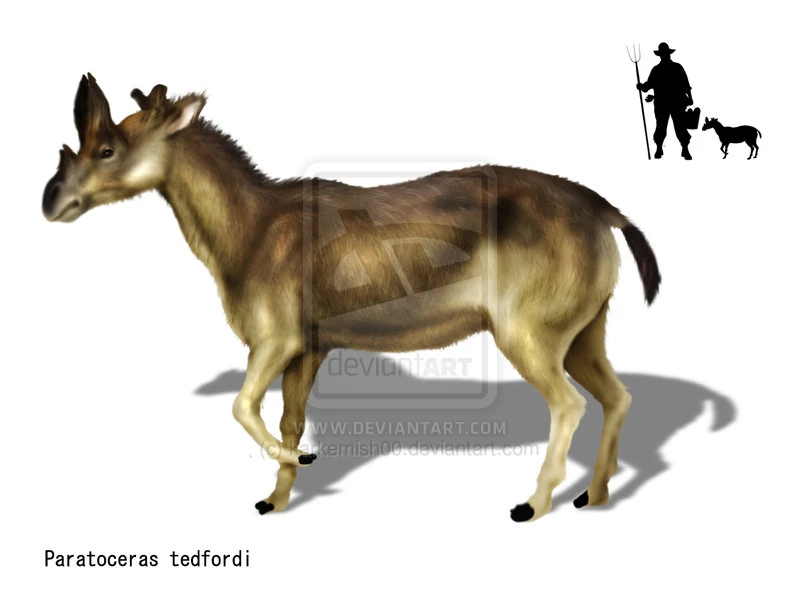
Figure 6 -
ParatocerasCredit:
karkemish00-d5b9mtm,
in
Dinopedia,
CC-BY-SA
Paratoceras was a genus of Artiodactyla, of the family Protoceratidae, that lived in North and Central America during the Early to Middle Miocene, 20.4 to 10.3 Mya. Paratoceras resembled deer, but were probably more closely related to chevrotains, so-called “mouse deer”. They had three horns, two on the top of the head and a third horn on the snout. In Panama, Paratoceras coatesi was found in the Cucaracha Formation.
Purussaurus

Figure 7 - Purussaurus
Credit:
Nobu Tamura, Creative
Commons Attribution
3.0 Unported license
Purussaurus was a genus of giant caimans that lived in the Americas during the Miocene. Specimens of Purussaurushave been found in Argentina, Brazil, Panama, and Venezuela. In Panama, Purussaurus were found in the Culebra Formation.
Equids: Cormohipparion and Dinohippus

Figure 8 - CormohipparionCredit: Bernor et al, 2018, Creative Commons Attribution-Share Alike 4.0 International license
The Late Miocene Alajuela Formation of central Panama has yielded two examples of extinct horses: Cormohipparion and Dinohippus. Both genera were widespread in North and Central America.

Figure 9 –
Dinohippus
Credit:
Ghedoghedo,
Creative
Commons Attribution-Share
Alike 3.0 Unported license
Pyruclia sp.

Figure 10 – Pyruclia
sp.
Credit:
Shellnut,
Creative
Commons Attribution-Share
Alike 3.0 Unported license
Who says that geologists have no sense of humour. In 2016, Bernard Landau, Richard E. Petit, and Carlos M. Da Silva published a paper in the Journal of Paleontology describing various gastropod fossils from the Miocene (Serravallian-Tortonian) aged Gatun Formation in Panama. Among the many snail fossils they found were two species of the genus Pyruclia, one they named P. tweedledee and the other they named P. tweedledum after two characters in Lewis Carol’s book Through the Looking-Glass, and What Alice Found There.
Marsupina sp.

Figure 11 - Marsupina
bufo
Credit:
Shellnut,
Creative
Commons Attribution-Share
Alike 3.0 Unported license
Fossils of two gastropod species of the genus Marsupina, M. bufo and M. nana have been found in the tuffaceous shales of the Pliocene aged Charco Azul Formation. Also called the chestnut frog shell, M. bufo was first identified by Jean Guillaume Bruguière in 1792, the snail lives today throughout the Gulf of Mexico, the Caribbean Sea and the Lesser Antilles; in the Atlantic Ocean from North Carolina to Northern Brazil. The smaller M. nana, also called the dwarf frog shell, was first identified in 1829 by William Broderip and George Brettingham Sowerby, and is currently confined to the Pacific coast from the Mar de Cortes to Peru. The presence of both species in the Charco Azul Formation points to a time when the Isthmus of Panama was being formed, as discussed in this paper.
Mineral Resources

Figure 12 - Protests in
Panama in 2023. Sign indicating that "Mining is Death"
Credit:
AnyGang, Creative
Commons CC0
1.0 Universal Public Domain Dedication

The mineral industry in Panama has its challenges. In 2023 there were serious protests that lead to the closure of the Cobre Panamá mine, which was once the largest copper mine in the regionand the only copper mine in Panama. Recently, the owners of Cobre Panamá have been allowed to remove stockpiled copper ore from the site. Silver and gold were also formerly produced at the Cobre Panamá mine
In other mineral production, the USGS Minerals Yearbook for Central America indicates that Panama’s mineral industry produces cement at two cement plants. The most recent statisitcs from the USGS for mineral production in Panama can be found here.
Figure 13 links to an interactive mineral occurrence map of Panama from Mindat.org.

Figure 13 – Interactive
Mineral Deposit Map of Panama
Credit:
Mindat.org
Summary

Figure 14 - Gatun Locks of
the Panama Canal
Credit:
User:Stan
Shebs, Creative
Commons Attribution-Share
Alike 3.0 Unported license
Panama does not look to be a promising place for mineral exploration. While the geology is favourable for copper/gold/silver deposits, like the Cobre Panamá mine, the politics are not favourable. The protests against mining were part of a general wave of dissatisfaction with the governmentand until these issues have been resolved, Panama is unlikely to be a good place for mineral exploration. There maybe upcoming opportunities for offshore petroleum exploration, as recent announcements indicate, so that may be worth keeping in mind. However, as with other countries in Latin America, Panama retains its Latin American pattern of governance, for good or for ill. So be warned if you plan to work there.
Standard Caveat
J. Robert Oppenheimer on freedom and scientific inquiry
The purpose of my weblog postings is to spark people's curiosity in geology. Don't entirely believe me until you've done your own research and checked the evidence. If I have sparked your curiosity in the subject of this posting, follow up with some of the links provided here. If you want to, go out into the field and examine some rocks on your own with the help of a good field guide. Follow the evidence and make up your own mind.
In science, the only authority is the evidence.